Prophecy Social on Somnia: Autonomous Prediction Markets Without Human Bottlenecks
Autonomous Prediction Markets on Somnia
A lot of people talk about decentralized infrastructure, but when you look under the hood of most Web3 applications, there is usually a centralized team pushing the buttons behind the curtain. Prediction markets are notoriously guilty of this. You place your bet, the event happens, and then you sit around waiting for an oracle or an administrative team to verify the outcome. It is slow, it is clunky, and honestly, it requires a lot of trust.
But looking at the recent rollout of Prophecy Social on the Somnia network, it feels like we are finally seeing a real shift in how these applications operate. Somnia has been pushing this concept of an Agentic L1, and after digging into their week one data, the architecture is starting to make a lot of sense.
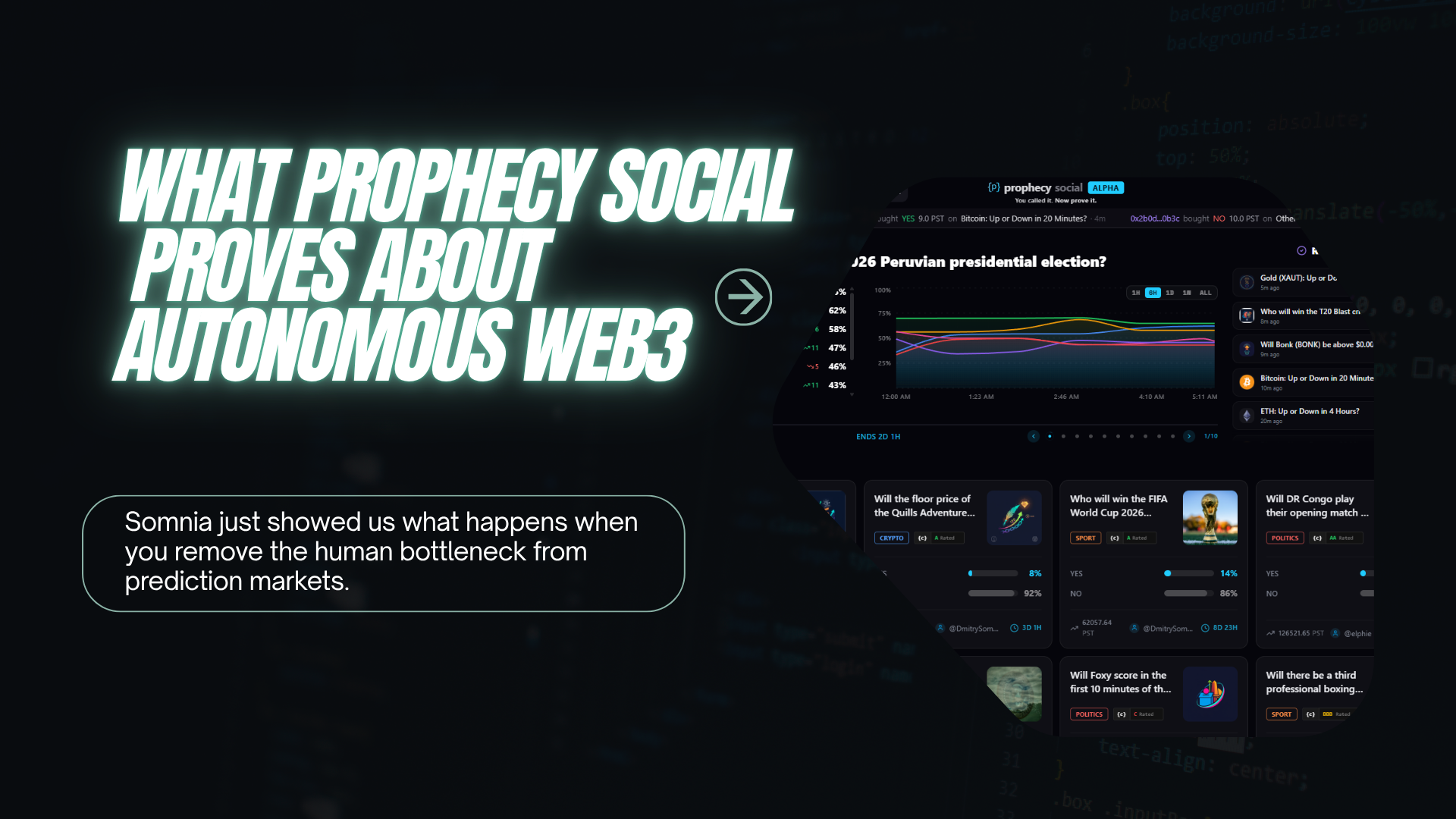
In just under seven days, Prophecy Social saw over 5,000 users jump in and spin up more than 2,000 prediction markets. The real hook here is not just the volume. The catch is that none of this required human intervention. From the moment a market was imagined to the second it paid out, the entire lifecycle was handled entirely by Somnia agents.
From Prompt to Market
Let us break down how this actually works from a user perspective. Usually, setting up a prediction market involves defining complex parameters, linking a reliable data source, and manually launching the contract. On Prophecy Social, it starts with a simple text prompt. You type out what you want to predict, and the network agents take over the heavy lifting. They structure the market, lock in the exact resolution criteria, and push it onchain. The user experience goes from managing a database entry to simply expressing an intent.
Network-Verified Resolution
The most interesting part of this infrastructure is what happens when a market actually closes. We have all seen crypto projects try to attach artificial intelligence onto their platforms as an afterthought. It usually creates massive trust gaps because the AI is running on an external, centralized server. Somnia handles this entirely differently. Their agents are embedded directly into the execution environment.
When it is time to resolve a market, these agents read the predefined data sources and extract the final outcome. But rather than relying on a single bot to tell the truth, this execution runs across validator nodes. The outcome requires network consensus before it is finalized. If you are taking a financial position on a market, knowing that the result is verified by the network itself rather than a lone, spoofable server is a massive upgrade. It essentially bakes the oracle directly into the chain's consensus layer.
Caliber Ratings
There is also the problem of permissionless spam. When anyone can create a market from a simple prompt, you run the immediate risk of getting flooded with poorly worded, ambiguous, or impossible to resolve bets. To counter this, they built in something called Caliber ratings.
Every new market is immediately scored the moment it goes live. The rating is based on how clear the resolution criteria are and the historical reliability of the underlying data source. According to the first week of data, this system is actually doing its job. The community naturally gravitated toward the higher rated markets, leaving the low quality, ambiguous ones ignored. It is a clean, automated way to let the protocol filter itself without relying on a centralized moderation team.
Incentives and Early Traction
On the incentive side, they rolled out a public leaderboard tied to $SOMI rewards. Users generated about 3.6 million points in week one just by doing normal platform activities like creating markets, taking positions, and keeping up their daily streaks. The points meta is standard for Web3 at this point, but it is clearly working to bootstrap the initial liquidity and attention needed for a prediction platform to thrive.
What This Means for Autonomous Applications
What stands out here is not just the early user traction, but what this means for the broader ecosystem. Prophecy Social is acting as a live stress test for the Somnia network. It proves that agent execution can handle real user activity at scale without breaking down. When you strip away the manual steps, you completely remove the ceiling on how fast a system can grow.
We are moving away from clicking through complex interfaces and heading toward an intent based model where you just tell the network what you want, and the agents handle the rest. If this first week is any indication, the infrastructure for fully autonomous applications is not just theoretical anymore. The era of the human bottleneck might finally be coming to an end.
Stay connected with the Somnia ecosystem:
- Somnia on X – Follow updates
- Official Website – Visit somnia.network
- Somnia Discord – Join the community